
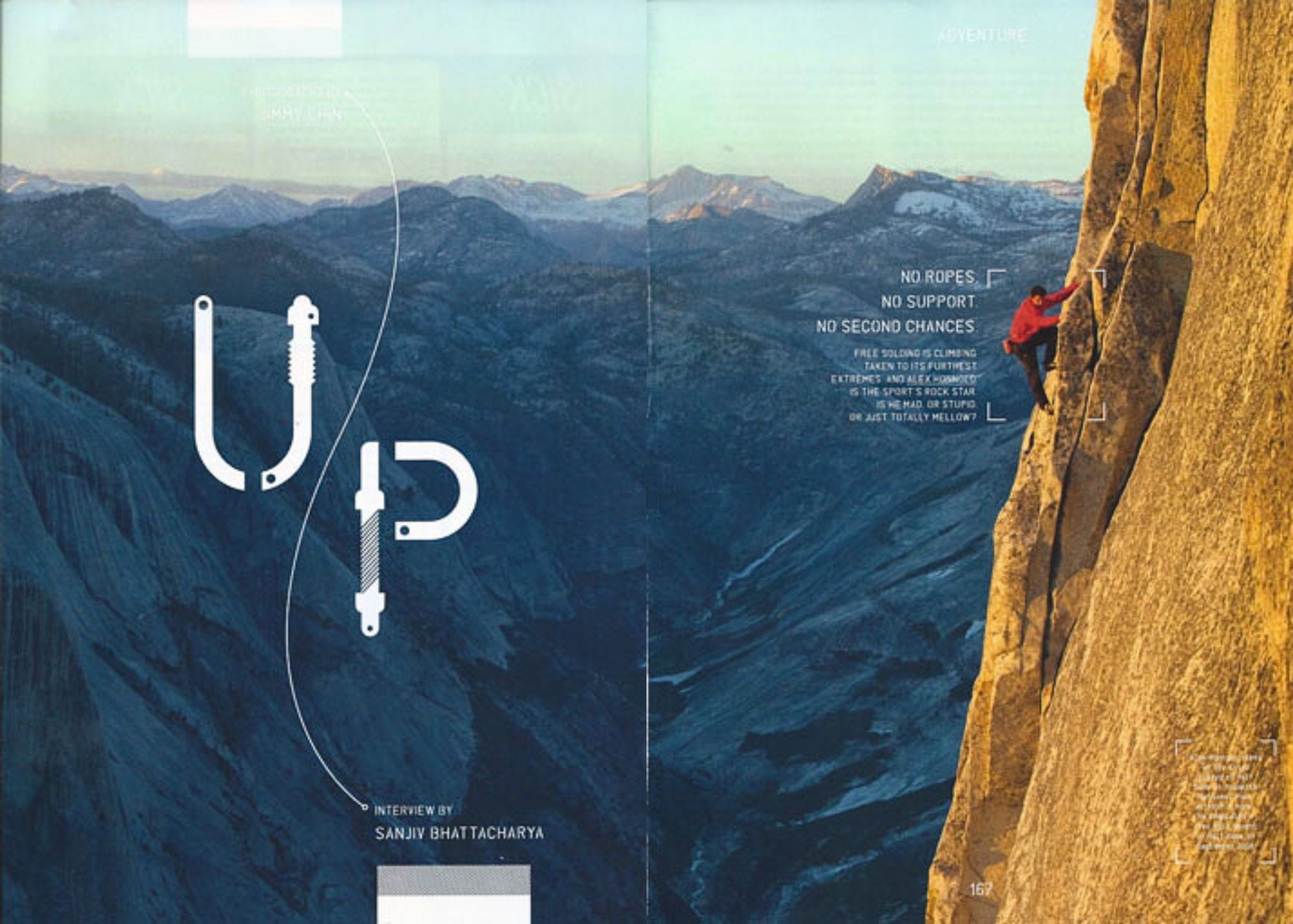
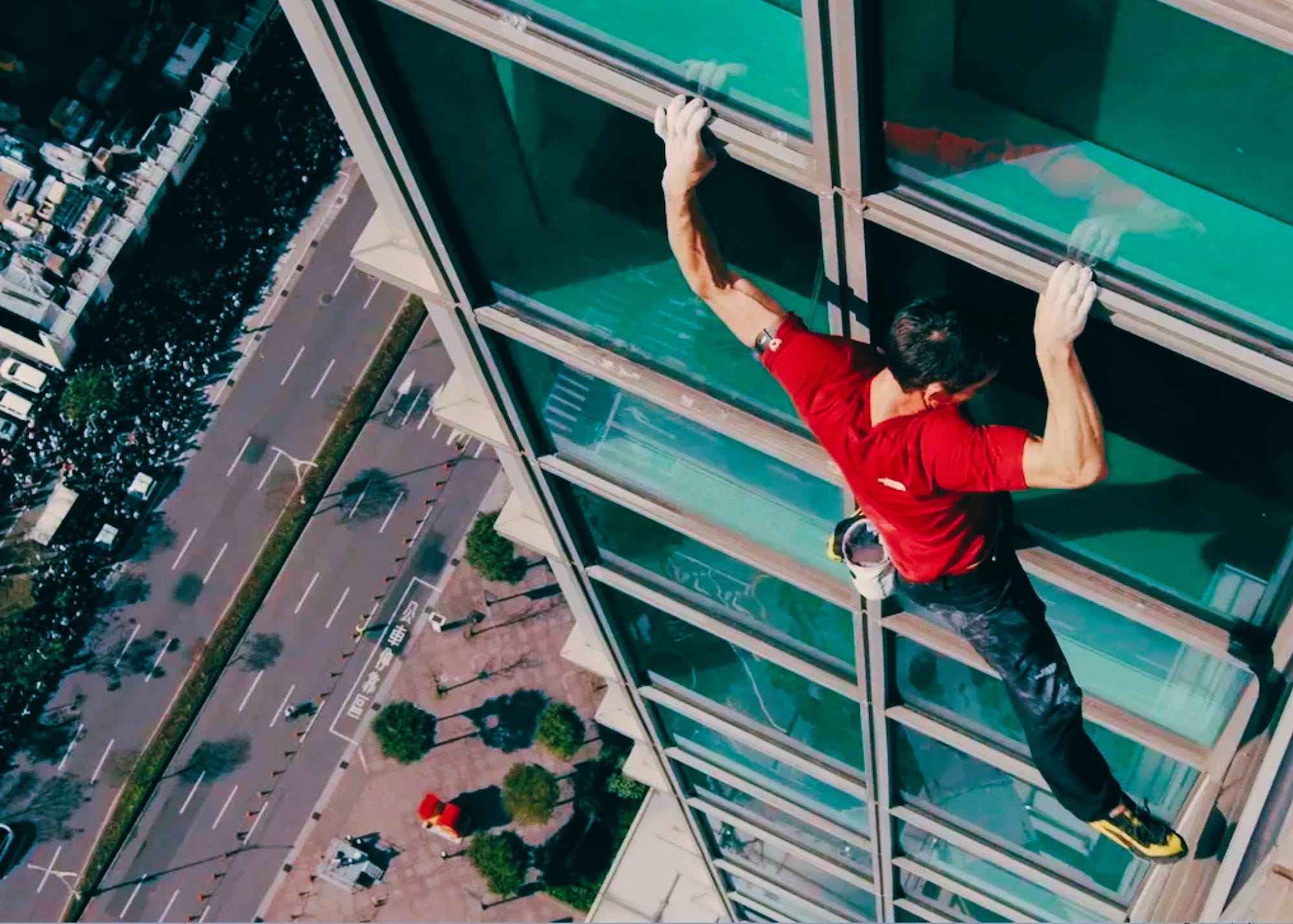
In the wake of Honnold’s latest astonishing feat of free climbing the Taipei 101 skyscraper, I thought I’d share the story of my day with him back in 2012 when I profiled him for Esquire. This was around the time of Free Solo, one of his early films, and he was emerging as one of the most incredible athletes of our time.
Below are two pieces that came out of that day. The first is the Esquire piece, the second is a coda about my own fish-out-of-water experience in his world. The running theme is a fear of dying, something that Honnold appears to have conquered. But not me.
———————————————
Eek A Mouse
It was 10pm in the black of night in Yosemite National Park, when Alex Honnold felt the first sharp tweak of fear. He saw a mouse.
No one could accuse Honnold of scaring easily but he was 400ft up a 3000ft wall at the time, the world famous El Capitan, an imperious sheer cliff of granite, as tall as ten Big Bens. And even though 400ft is a piffling altitude for the likes of Honnold, it’ll still kill you if you fall, which is always possible when you’re up there without ropes or aids or a partner, a style known as ‘free soloing’. Not for the first time, Honnold was on the ultimate precipice - one slip, one mishap, one bite from a mouse, and he would die.
“Things were already going wrong,” he tells me later. “The rock was damp because it had dumped rain two days earlier, and I forgot my chalk bag - you need chalk to dry your hands. Also, for climbers, a chalk bag is like a psychological crutch. Whenever you’re nervous, you chalk up.”
Normally, he would have hiked back to the van to get his chalk bag, but that would have taken too long. He was attempting to climb the Triple — the three biggest walls in Yosemite — in 24 hours. And the clock was ticking. He’d started with Mt Watkins (2000ft) at 4.30pm that day, when the wall went into the shade. The plan was to climb El Capitan through the night, and then Half Dome (2000ft) the following morning.
And yet, there he was, alone on a wall in the darkness, sensing his fear flutter inside him like a flock of gulls. His position was awkward. He clung onto a diagonal crack with both hands, with his left foot wedged in below at such an angle that he couldn’t see it, even with a headlamp. The only way forward was this one hold above him, a ‘pod’, the very hold that the mouse had scurried into. And he couldn’t flush him out – he slapped the rock, he whistled, nothing was working.
“I didn’t want to get bitten. My rational brain knew that the mouse was more scared of me than I was of him. But that’s how fear works. When a few little things go wrong, it’s easy to start down that road where you build this escalating sense of panic, like, ‘oh fuck oh fuck oh fuck, I don’t know what to do…’”
It took him thirty long seconds to, as he puts it, “nip that shit in the bud” – to convince himself that the wet walls, the no-chalk, the mouse, none of this mattered. And he went on to make history. He topped El Capitan at 3.30am, free soloing most of it but using aids for the tougher sections. He then hiked down, drove over to Half Dome and scaled that before lunchtime.
“The Greatest Rock Climber Ever”
It’s hard for a non-climber to appreciate how impressive this is. Rock climbing is a rarefied and impenetrable sport in some ways. It combines the primal simplicity of a man on a wall with all the sub-categories and technical lingo of a niche and obsessive subculture. The greatest climbers are virtual unknowns, and the greatest feats are scarcely witnessed by anyone. There’s no Olympic event or national team. And though the sport began with Victorian mountaineers in the Alps, it feels young and new, in part because successive generations, thanks to better equipment and training, keep raising the bar so dramatically, year upon year.
Take Honnold’s Triple. For context, any one of these walls would take several days for a skilled climber. In fact, in 1957, it was considered a pinnacle achievement when a team led by Royal Robbins took 5 days to summit the Half Dome alone. As for the Nose Route of El Capitan, the first person to free climb it – using ropes only for safety – was Lynn Hill in 1994, who took 23 hours. A decade later, Tommy Caldwell accomplished Hill’s feat in 12 hours. To date, the closest anyone has come to Honnold’s Triple was in 2002, when Dean Potter free-climbed both El Capitan and Half Dome in 23 hours.
Honnold speed-climbed all three in 18 hours.
Ask most climbers about Honnold and you’ll hear words like “insane”, “incredible” and “not human”. But whether he’s the best rock climber alive depends on your definition. By his own admission, he’s not the most technically skilled. While some, like Chris Sharma, can climb pitches that are graded 5.15 in difficulty, Honnold’s limit is 5.14.
But rock climbing tests more than just skill. Unlike most sports, climbers are routinely required to overcome their fear of death, to restrain the galloping panic that can begin when a mouse runs into your hold. And this is where Honnold reigns – he is the world’s foremost free soloist, a style of climbing so pure and terrifying that only a tiny fraction of climbers even dare to attempt it.
Free soloists climb without ropes – that is, they risk death at every moment. It’s already an irresistible metaphor for a human speck to scale a colossal wall, but when that speck has no safety rope, it becomes something epic and astonishing. Honnold’s most celebrated free-soloing accomplishment was Half Dome in September 2008. No one witnessed it, but when he recreated a moment for a short film entitled Alone On The Wall, it was so gripping that it led to stories in National Geographic, Outside, and 60 minutes. His accomplishment of the Triple will only inch him inexorably towards his next goal, one that he has been talking about for years – to free solo El Capitan, a feat that is almost beyond comprehension. El Cap is as high as three Eiffel Towers.
“It’s the next logical step, but it’s a freaking big one,” he says. “It would take nearly five hours, and a bunch of the hard stuff is up at the top. I don’t know. Someone’s going to do it.” [Note: Honnold did this 5 years after this piece came out, in 2017]
Race-car drivers and big wave surfers risk death too, but they have at least the illusion of safety – whether it’s helmets and roll cages, or just the knowledge that they’ve wiped out before and survived. There is no such comfort for Honnold. He slips, he dies. The end.
“For surfers, the moments of peril last minutes,” says Peter Mortimer, of Sender Films, who shot Honnold’s Triple. “Alex has to maintain perfect concentration for hours. That’s why free-soloists are so incredible. Climbing is about boldness as well as strength. And Alex’s boldness and vision are on such a level that, for a lot of us, he’s the greatest rock climber ever. And he’s only 26.”
“It’s true. My balls are pretty freaking huge.”
A few hours after he finishes the Triple, I meet Alex outside my hotel in Yosemite. We planned to hang out for a few days, so I drove up from Los Angeles. But, typically, he didn’t tell me about the Triple – he never announces this kind of thing until after it’s over. So I have no idea what he’s just done. He just looks like some skinny kid in flip flops, shorts and a hoodie, standing in the car park looking a bit sunburnt and spaced out.
“Dude, I’m like crushed right now,” he says. “I could use some food, but after that I’m going to have to crash.”
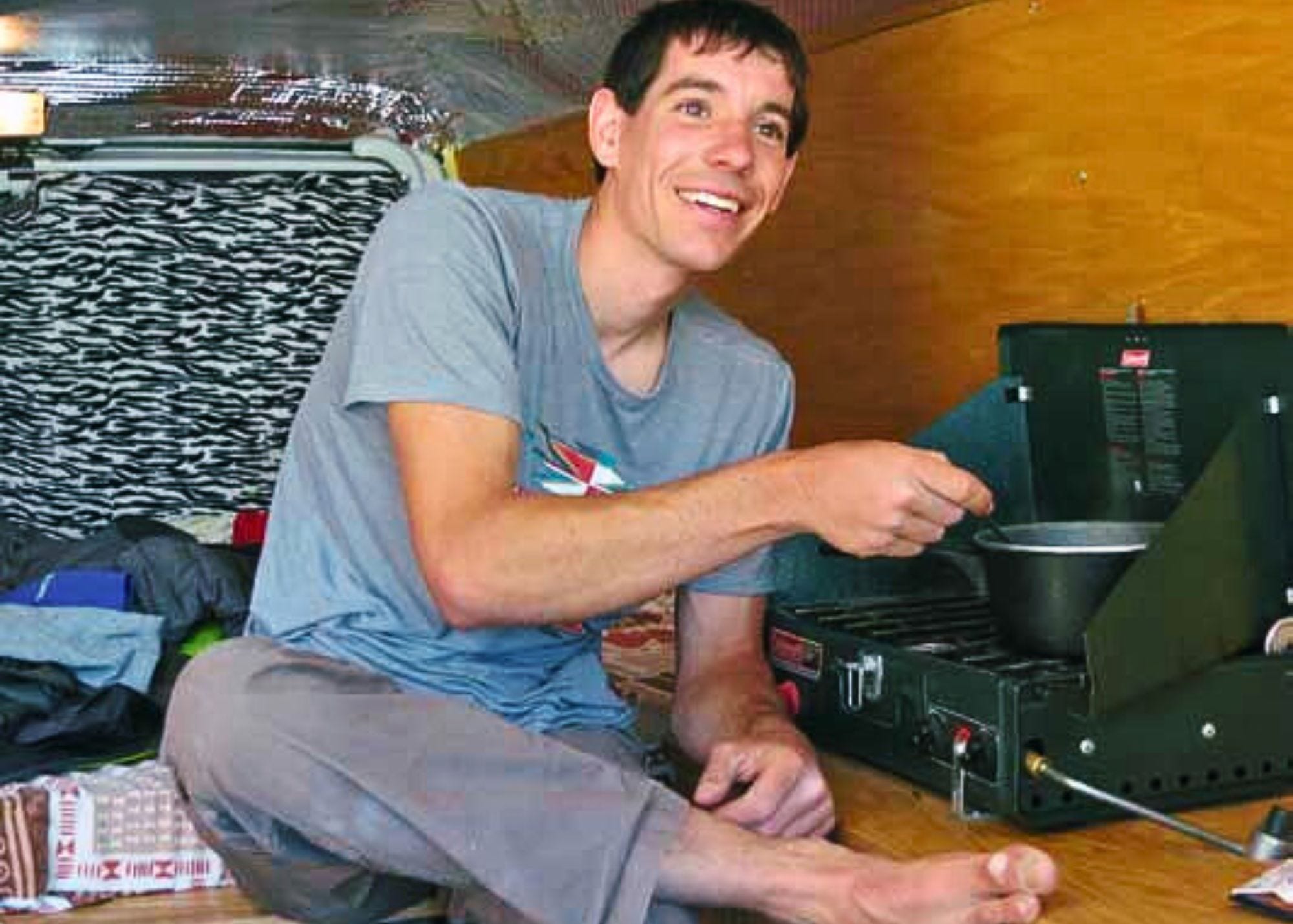
As we eat, the enormity of his achievement becomes clear. But I have to dig it out of him. After three days with him, I think Honnold may be the most humble and extraordinary person I’ve ever met. Nothing about him suggests “elite athlete”. His hands are broad, his fingers wide and thick, but other than that, he looks unremarkable – a slim 5’11, 160lbs, with sticky-out ears. He’s intelligent and well read, funny and fluent in the Cali-lingo of “dude”, “heinous”, “sick” and “gnarly”. He’s utterly driven and clean-living – he’s never had a drink because “I don’t see the point” - and he’s apparently unmoved by material comforts. After we ate, that first night, he spent the night on a mattress in a shabby white van in the car park where he’s lived for five years now.
“It’s perfectly functional,” he says, pointing to a little gas hob, and the storage under his bed. There are climbing ropes and carabiners (climbing hooks) all over the floor, a cooking pot and boxes of Clif energy bars. “A lot of climbers live in their vans. It’s just easier.”
He’s up at seven the next morning, painting antihydral paste on his fingertips to stop them sweating, and sanding down any loose shreds of skin. His hands, he says, are his only physical advantage: “The skin is basically indestructible. I never get cut.”
Incredibly, on the day after finishing the Triple, he’s about to climb again. Only it’ll be “supermellow” this time, nothing “extreme” or “hardcore” – just a photoshoot with a sponsor, the brand Black Diamond. He has six sponsors – The North Face, Black Diamond, La Sportiva, Clif, New England Ropes, and recently, Ball Watch, a luxury watch company, which gave him a $3000 watch. “I feel like a total douche,” he says. “That thing’s worth more than my van.”
Honnold has a purist’s suspicion of marketing departments and PR. He’s not at all seduced by what he calls “the bullshit”. But his sponsors provide him with a salary and a travel budget, which given his simple needs, affords him a lifestyle that is, he says, “pretty fucking awesome.”
Last year he travelled to Morocco, England, France, Spain, Chile, Mexico, Poland and Canada. The year before was Chad, Jordan, Israel, Turkey, Greece, China… He mostly goes where he wants, when he wants, with no strict agenda, and in between, he lives in his van, climbing all over the US and crashing occasionally at his mom’s place in Sacramento, his only permanent address, where he spends “maybe 14 days per year.”
A materialist would milk his fame, and pursue a van sponsor, at least. “But this van works fine!” he says. “And we’re way too consumerist in this country, anyway.” Besides, he doesn’t love being a celebrity. “It’s funny to get sick of people telling you how inspiring you are, but I mean, it’s just rock climbing. I didn’t save the world.”
You’re not proud of your achievements?
“No, I am, I guess, but that’s what I do. I’m a climber. Everyone’s got their thing. I could never hit 30 free throws in a row, but a basketball player would think that was trivial.”
Lebron doesn’t die if he misses. Free soloing and free throws aren’t the same. One takes courage. Like his fans say, ‘it must be hard climbing with balls that big.’
He grins. “It’s true. My balls are pretty freaking huge. But I wouldn’t say courage. Courage is doing something that you don’t want to do, like a soldier. I want to be half way up a mountain. It’s awesome.”
“Most free soloists die. And they die on easy pitches, not hard ones.”
While we’re at it, there are a few misconceptions about free-soloing that he’d like to address. Firstly, he only free solos a few times a year – most of the time he uses ropes like everyone else. Secondly, he’s not risk-addicted and he doesn’t have a death wish. And thirdly, it isn’t that dangerous anyway.
“Look, I wouldn’t free solo something that I wasn’t confident about. I want to play with my grandkids. I’m saving for my retirement. The reason I do these long solo climbs is because it’s a cool way to climb. I like the simplicity. You don’t have any gear on you, you don’t have a partner, you move faster.”
One of Honnold’s heroes, Peter Croft talks about flow. Croft was the first man to free solo the Astroman wall in Yosemite (5.11), among other accomplishments. “I compare it to a runner’s high,” he says. “With ropes and a partner, you’re always being interrupted, but with free soloing, you can just go. It’s just you on the rock reacting to what’s going on. I’m so focused that when I get to the top, everything looks different, the colors, the light.”
Honnold is less poetic. “I’m more focused, for sure, but it isn’t like all of a sudden the harps strum and you’re in some magical state.” A self-described militant atheist who exclusively reads non-fiction, he isn’t inclined to rhapsodize. As he drives from one wall to the next, he points at the road. “Look, I’m at risk of dying right now.” And he’s right – he’s slaloming around mountain bends, steering with his knee, checking his iPhone with one hand and eating a banana with the other. “Driving is probably the most dangerous thing I do. One momentary lapse and we’re both dead. We’re always at risk. And we’re all going to die eventually anyway, so you may as well lead the life you hoped to lead.”
Not all climbers agree. Tommy Caldwell – Honnold describes him as “a much better climber than me” – doesn’t mince his words. “What Alex does is amazing but I will never free solo. I’ve fallen unexpectedly many times on easy pitches and if I didn’t have a rope, I’d be dead.”
Before Honnold climbed the Triple alone, he free-climbed it with Caldwell, and during that climb, Caldwell fell twice. “Alex just says, ‘that’s never happened to me…’ And I think that to be that good, you have to think that way. Alex and Peter have this calm way about them – they don’t see free soloing as some conversation with death or enlightening experience. But the fact is, most serious free soloists die. And they die on easy pitches, not hard ones.”
In the last 40 years, nine Americans have raised the bar on free soloing, and five are now dead. The most recent was John Bachar in 2009, a close friend of Croft’s, who died on a route he’d free soloed many times before.
“I know the risks,” says Honnold. “I’ve fallen sometimes when I haven’t expected to, with a rope on, too. But that’s with a rope, you know? I trust myself that, when it really matters, I won’t fuck up.”
‘I’m scared, I’m really scared, oh God oh God oh God…’
All Alex ever wanted to do was climb. His mum Deirdre says, “even as a toddler, he always wanted to be high up. I’d turn my back and he’d be on top of the refrigerator or the closet.” His dad would take him to the local climbing gym in the suburbs of Sacramento, and the obsession took hold. So much so that come his first year at the University of Berkeley, he placed 2nd in the youth national rock climbing championships and was looking forward to the world championships in Scotland later that year.
That was the year it all changed for Honnold. His folks were both teachers, and he’d aced high school, but he had no interest in college. He hardly showed up for lectures. Then his dad died of a heart attack, leaving Alex with a chunk of money, supposedly to finish his education. But Alex had other ideas. “Dad was part of the pressure to go to college in the first place. So suddenly, he’s gone, I have this opportunity to go to Europe and enough money to live on the road for a while…”
He did poorly in Scotland, coming 39th. But when he returned, he knew what he wanted. His Mom gave him her Chevy Minivan, and for two years he drove around the American West climbing with whomever he could find. And where he didn’t know anyone, or was too intimidated to make friends, he climbed alone.
“I must have free soloed thousands of pitches,” he says. “And I had all kinds of fucked-up experiences, climbing the wrong route, and getting really scared. But I learned that, to a large extent, the cruxing was self-imposed”. “Cruxing” is climber-talk for those moments of difficulty, fear and panic – those times when, as Honnold says, “you go ‘I’m scared, I’m really scared, oh God oh God oh God…’”
He emerged from this period in 2007 as a world class free soloist, conquering big walls in times that made the climbing community sit up and take notice. And then he scaled Half Dome in September 2008, an ascent which so captured the imagination that it essentially launched him as a pro-climber.
Half Dome has also given Honnold perhaps his most gripping climbing story. It was a moment towards the end when he was cruxing badly on a smooth slab at an 80 degree incline. There were just no good holds available. At his level, he’d happily put all of his weight on an edge as slim as a dime so long as it was sharp, but all he could find were smooth, rounded dimples. Could he trust them? If he slipped, he’d slide down the slab and fall to his death. And yet he was so close to the peak – he was 1900ft up – that he could hear the tourists at the top.
“I’d been stuck in that position when I practiced it, that was the thing,” he says. “I just thought I’d find another way when the time came. But I couldn’t. So I started trying all these other little footholds and rejecting them, because they were even worse.”
There was, however, a bolt within reach, with a big carabiner attached, left by a previous climber. He could easily grab the carabiner and hoist himself up. “But I didn’t want to climb all the way up there only to cheat on one move. And at the same time I was like, ‘how fucking dumb would it be to slide off this mountain when there’s a carabiner right there?’”
In the end, he compromised. Heart racing, breath-quickening, he touched his finger on the bolt, so that if he started slipping, he could grab it. He didn’t need to in the end. And he emerged at the top, pumped and shirtless.
“It was so surreal. I was all stoked, and all these people were up there eating sandwiches and talking on cellphones. They didn’t even notice me because I didn’t have any climbing gear on. I just looked like some idiot who got lost. So I just took off my climbing shoes and started hiking down. And then all these people came up to me saying, ‘woah you’re hiking barefoot! That’s hardcore!’ I was like, ‘whatever dude. You have no idea.’”
Not Only Sick, But Heinous
The ‘supermellow’ day of shooting turns out to involve hiking up to the rock face, climbing, hiking down, and then doing it again at another face. And another, and another, until sunset. For this soft-bellied suburbanite, the hikes alone are murder. But Honnold is having fun. He laughs when the Black Diamond Team ask him to wear a helmet, he laughs: “I know I’m all about safety first, guys, but this is retarded.” He wears it anyway and spiders easily up a wall that has just turned to gold thanks to a sunset that, by common consensus, is not only sick but heinous.
By nightfall, we’re back in his van, heading back to my hotel. He’s just dropping me off there, he doesn’t have a reservation. The Black Diamond team is staying elsewhere. Only Honnold, the star athlete, is without a proper room for the night, not that he cares. He’s talking about his summer plans.
We pull into the car park. He looks pleased. It’s an easy place to park for the night – plenty of room, no watchmen to give him hassle.
“You see?” he says. “Not everything in my life is super-intense. Sometimes I just do these boring photoshoots all day. I swear a lot of the aura around my life is shit that people project onto it. The truth is way less exciting. Your article should say, ‘I met this dude, he’s totally mellow and he trains real hard and climbs quite well. The end.”’
OK, Alex. I’ll say that.
“Oh and dude, can I get a quick shower in your room, and charge my laptop?”
This is the second piece, about how I came unstuck on the mountain, embarrassingly so.
Softcore And The Mountain Men
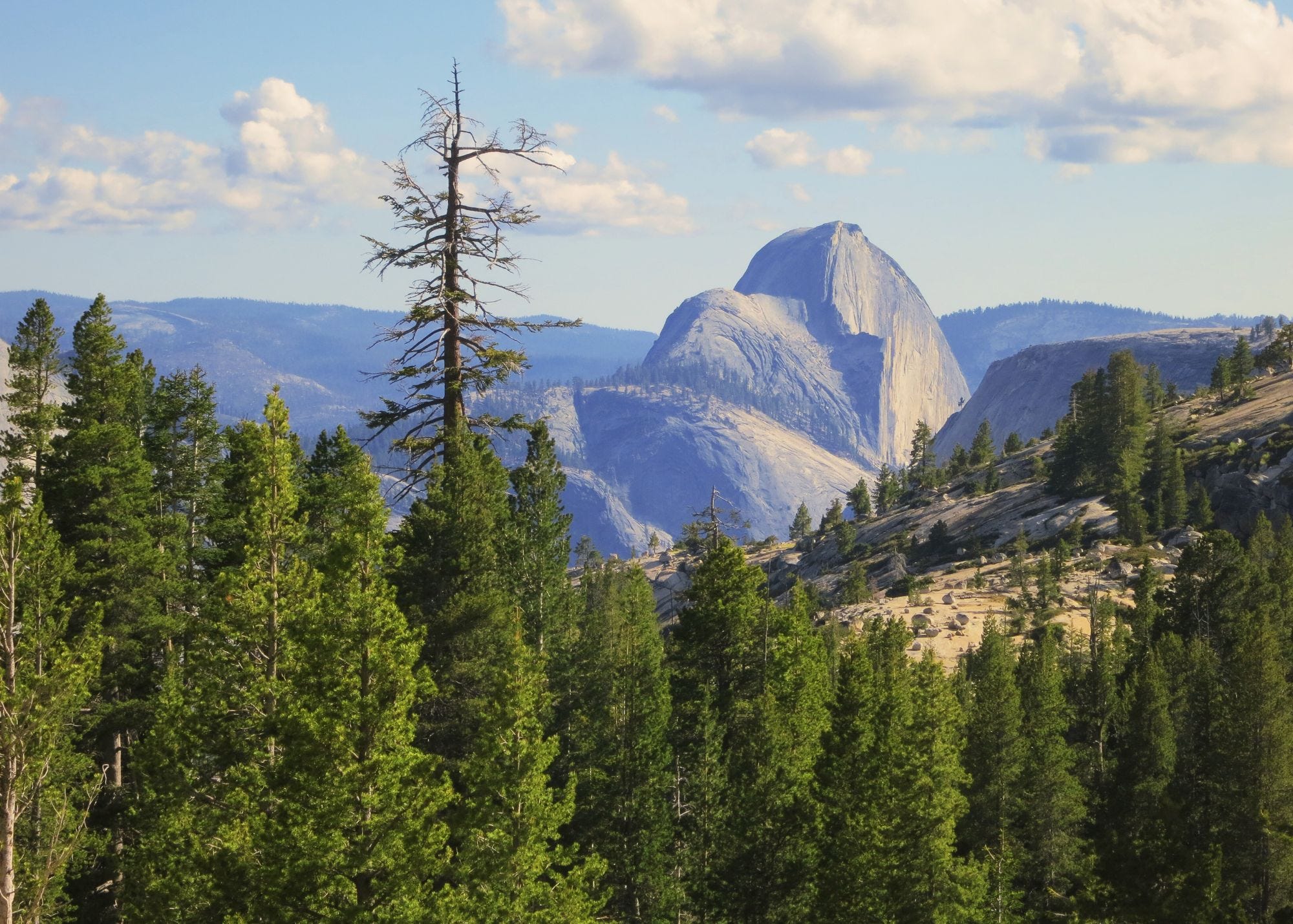
I shouldn’t be here. Wherever “here” is. All I can tell you – and the rescue services if I could call them – is that I’m somewhere in the breathless altitude of Tuolomne, just east of Yosemite National Park. I came here with a crew from Black Diamond who are going to be shooting a campaign with Alex Honnold, but they all marched off up the mountain a long time ago. And I can’t see them anymore. All I can see is a load of trees and rocks and bushes in all directions, all of it steep and forbidding. I’m a speck here, lost among bears and snakes and monsters. And as it starts to get dark, I may as well be wrapped in a brown paper bag with soy sauce and napkins.
That was three hours ago. Three going on five, going on 127 Hours starring James Franco.
For the first two hours, I tried to keep climbing. I listened to that voice that said, “if you find the other guys, you’re less likely to get savaged by bears.” But I kept climbing up cul de sacs and followed ledges to edges that just fell off and died. And when I tried to retrace my steps, I ended up somewhere different. It was never quite the same rock or the same tree. I wasn’t going around in a circle so much as a spiral, and I never got back to where I started. Although in a way, I suppose did.
The panic hasn’t set in yet. There’s still time before darkness descends and I doing all the things - I’m breathing, I’m staying calm etc. But the more I tell myself to “stay calm”, the more I sound like I’m panicking. Which… OK, it
Here’s what Alex told me. He said, “dude, let’s hang out while I do some press shots with Black Diamond, they’re a sponsor. We’re going to take some pictures in Yosemite, it’s going to be supermellow. You should probably bring a book or something because most of the day, you’re going to be just hanging out while I climb.”
A mellow day in the country, I can handle. So I brought my little pot pipe, some magazines and a couple of bags of Kettle Chips in case of munchies between meals. I couldn’t wait. The scenery looked gorgeous on the drive up.
But then we met the Black Diamond crew, every one of them in a puffy jacket and proper boots. They were looking at maps and saying “we’ll go here for this shot and there for that shot” and no one mentioned a leisurely lunch along the way. As they packed their rucksacks with sandwiches and trail mix and Gatorade, they looked at my little laptop bag with its dainty little side pockets and asked politely: “hey, you want to borrow a rucksack? Might be easier for the hike.”
What hike?
“We have to hike to the rock face for Alex to climb. About forty minutes, no big deal.”
I knew right then I was fucked. I felt it in my gut. I should have bailed on the spot and booked a B&B or something. Instead, I took their rucksack, and put my laptop bag in it, which made it kind of lopsided. And I pretended that everything was just fine.
Hike #1 started beautifully. They all set off, trudging quietly up into the woods, and I’m marching alongside, trying to crack jokes and make friends. But after two minutes—two—I’m wheezing like Muttley, choking for oxygen, and lagging badly. The fat kid on cross country. The pity case, the liability, the first to get eaten. There was one bit where the snow had hardened and with my smooth-soled sneakers, I came sliding back down into the dirt with every step. “Fucking bollocks fuck.” Then a girl called Sandra said: “Kick your toes into the snow to make a step and push up.” Turned out, I didn’t just have the wrong shoes, I didn’t know the most basic techniques of… walking.
I’m a different tribe. I come from a planet of wine tastings and memory foam in the endless summer of LA. This lot are from Utah and Colorado where they ski and climb and grapple with nature. Immeasurably tougher and fitter, and wilder too, I never heard so much burping and farting. Proper growlers and no one giggles. Maybe farts aren’t funny in the mountains. Maybe expelling waste gases is a matter of survival.
They have their own language which I don’t fully understand – words like “beta”, “cruxing”, “burly” and “rally”. But “hardcore”, that one I know. Outdoors types love a bit of hardcore. So I asked, trying to endear myself in my ineptitude, “does that make me softcore?” And it stuck. Softcore. And Softcore gets treated like a lady. The photographer, Burr, offered to walk with me on the hikes, setting off earlier so we didn’t slow everyone down. Nice guy Burr, even offered to carry my rucksack in the steep parts.
But today, the schedule was too tight. They had to get the afternoon light, and there wasn’t time to walk me up at a ladylike pace. So I got left behind. And now I’m stuck, half way up a hill, in the dense woods, trying not to let the dark thoughts breach the levees.
Far as I can tell, my options are:
1) Stay put until I hear their voices, and then start hitting the high notes like this guy.
2) Accept that I may never hear a human voice again, so better to just write a note to whomever finds what’s left of me after the bears.
3) Go down to the road. At least I can see it from here. Be a man, Softcore, your time has come.
Oh the road! It looks so beautiful from here. A pristine flatland of tarmac and white lines, so much more picturesque than all those blah blah mountains and lakes. Nature is an asshole. It lures you in with peaks and ponds and gentle, duck-down names like Cloud’s Rest but the closer you come, the meaner it gets. It’s granite and rabies and murder. It feeds you to the worms. All I want is to return to my high crime gang neighborhood in LA. I’ll be safe there.
I spot a ridge down below that runs diagonally towards the tarmac though I can’t tell whether it reaches. It’s not the way we came, but so what? At this point, it’s my only hope. So fuck it, I’m going to try. He who dares, Rodney. And even if it doesn’t work, I’ll at least be visible to emergency services.
But the further I go down this ridge, the hairier it gets. Your eyes tell lies from up high. What looks smooth may be nobbled. Gentle slopes have steep and plunging dips. And towards the end, I’m in a predicament. Just fifty feet from the street but this last stretch is treacherous, slick with water.
I crouch down and cling to the rock on one side, like I’m clutching a banister with both hands and trying to get traction with my feet on the way. But the banister is a jagged Toblerone of wet rock, and my feet can’t always find support. At times, I’m just hanging there by my fingers, heart pounding, and my backpack swiveling awkwardly from right to left shoulder, throwing my balance completely.
I’m feeling the strain now. This isn’t a position I can hold. So, clinging on with my right hand, I unclip the pack from my waist, switch to my left hand, and then let the thing drop. Goodbye laptop. And I claw down a few more feet until the ridge just stops. My knuckles are bleeding at this point, the blood running down the rock with the water. And it’s getting harder and harder to keep hold. My fingers are sliding.
There are two choices – either just slide off, and hope I land somewhat upright, or jump now, however high up I am. And there’s no choice really. I have to jump and quickly. Push myself off the wall and turn around mid air so that I land on my front and not my back.
I’m sure it looks comical from the road – a little Indian guy clinging desperately to a rock barely twenty feet up from the street. But to me, it’s epic. And when I hit the tarmac, feet and hands, like a panther, no scuffing, it feels like a triumph. It turns out, the rucksack is reachable, caught in some roadside shrub, undamaged.
When the guys get back and see me in the van, all bloodied up and shivering, they laugh.
“Softcore, what happened?” Says Burr. “You took a piece out of your finger there.”
I tell the story – how I lost my way, shat myself, and ended up holding on for dear life. And Alex, the greatest rock climber in the world, says “we got a word for that. Vision Quest. That’s like when you’re out hiking on your own and you don’t know where to go, and you’re tired, you’re cold, you don’t want to be there anymore – you just want to be down. We say, ‘oh, I was vision questing’, like, ‘I was just guessing and hoping for the best.’”
It’s absurd that Alex is relating my little drama to his own experiences—hours in freezing temperatures, sometimes without even any shoes. But it goes to show what a nice guy he is. What a mensch. He’s including me in his world.
“Dude, everything’s relative,” he says. “What’s softcore to me is hardcore to you, but it could be the other way around depending on what we’re talking about.”
These are the things that people like Alex say to make people like me feel better. But I know this – my weed survived the tumble. So I’m going to stick my own version of Vision Quest from now on.
Loved this. And while the skill set learned in the land of wine tastings and memory foam mattresses might have felt glaringly deficient at the time, you got through the cruxing, climbed down to safety in the end and Alex H praised you - not a bad day! So when are you headed to Taipei to write about getting stuck in the elevator in the 101 building?😁.
Great piece - thanks Sanjiv.
This is hilarious: “even as a toddler, he always wanted to be high up. I’d turn my back and he’d be on top of the refrigerator or the closet.” This was an amazing read, thank you. I'm inspired and love "vision questing". Goes to show how fear prevents us from experiencing life.