
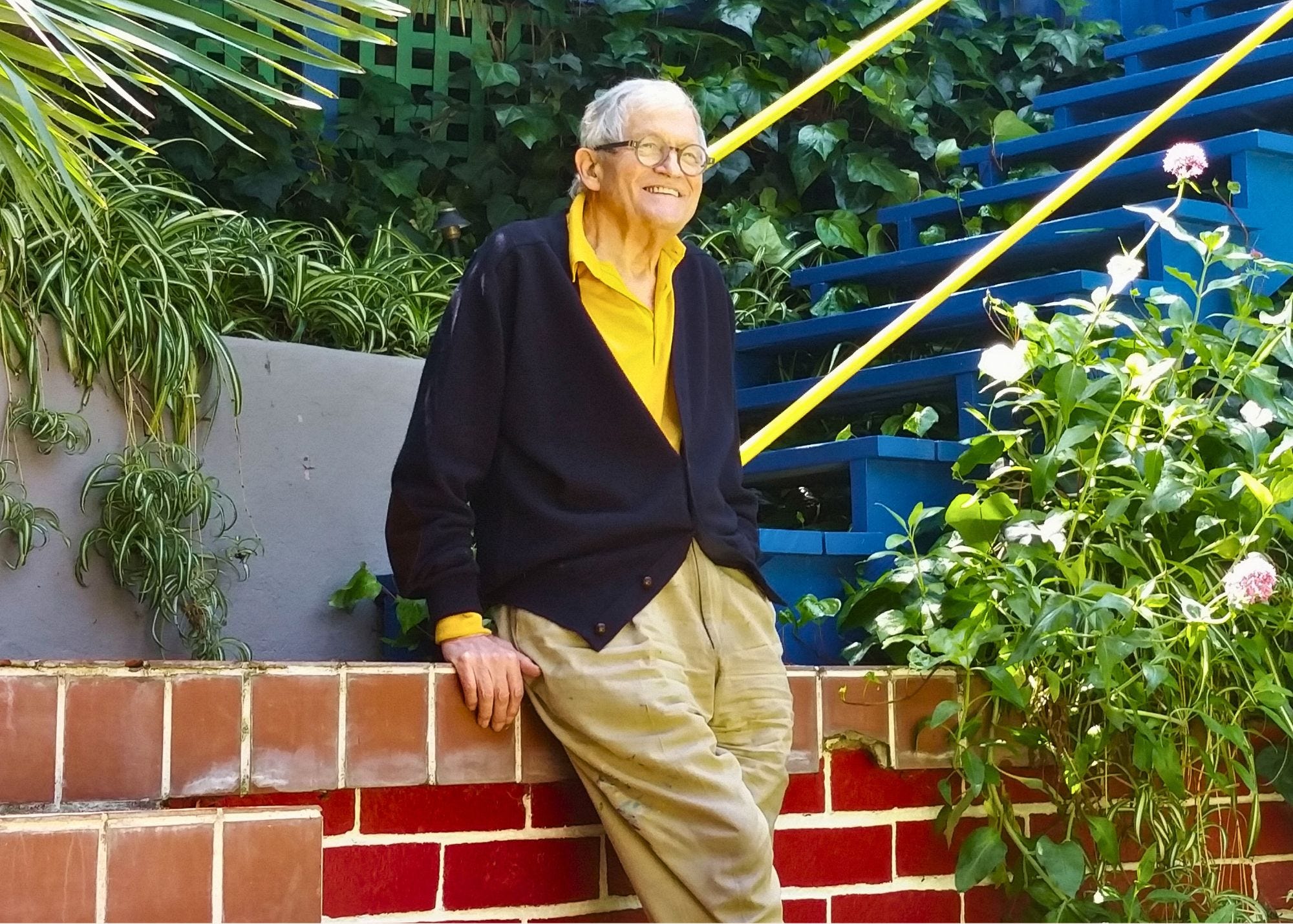
Of all the interviews, over all the years, the morning I spent at David Hockney’s house in the Hollywood hills remains the most vivid. Still cast in the sunny LA palette that he so loved. I entered his world up there, of calm and creativity, easy humor and the quiet inspiration of a great man doing his work. And it has stayed with me.
The original commission was for Esquire’s classic format What I’ve Learned, but he gave such a great interview that I also wrote a profile piece for Harpers Bazaar, which I’ve appended below, with a smattering of pull quotes from the Esquire interview. (Big thanks to Alex Bilmes and Tom Macklin for the commission.) We had a wide-ranging conversation about age, modernity, art school, class, being gay, cocaine, cigarettes, tolerance, criticism, tragedy, depression, perspective… He was thoughtful, funny and generous. A lovely man.
I remember leaving his home that day and winding down the hill, full of warm and energizing conviction. We all know, at least on paper, that being an artist isn’t about exhibitions or awards or interviews in magazines. It’s about making art every day. Noticing the world and getting it down. But I had never seen that simple truth embodied so fully and with such grace.
“You have to shut out the noise,” he said. And he chuckled. “Easy for me to say, I’m practically deaf!”
RIP.
=================================
March, 2016. Another busy morning at David Hockney’s home studio on Montcalm Avenue, a gorgeous sun-dappled cul-de-sac in the Hollywood Hills. His studio manager Jean Pierre (JP) is busy at his laptop. His personal assistant Jonathan is working a projector at the back. And the artist himself, with the paint on his trousers and the small round glasses under a thatch of hair – looking very Hockney, it must be said – is giving a guest a tour: me.
“When I bought the house in 1979, this was a paddle tennis court,” he says, in his gentle Yorkshire brogue. “But I have no interest in paddle tennis or any other sports for that matter.” So he converted it to a studio, an expansive white cuboid of a room where he can work, which is what he’s really interested in. And in recent years, he has been especially busy. On the walls today are portraits against blue from his forthcoming show at the Royal Academy, “82 Portraits and a Still Life”, and he finished them all in just three years. “I would take two or three days each, painting for seven hours a day,” he says. “Well, to ask someone to sit for a week, they’ve got to rearrange their lives, haven’t they? But three days is a long weekend.”
In LA no one asks you where you’ve been, where you’ve come from. There’s all kinds of people here, everybody’s from somewhere else. It suits me.
We stop in the center of his studio, where Hockney points to the floor and smiles. “There, that’s the whole thing!” he says. And at our feet is a knee high model of the RA gallery itself, with thumbnail miniatures of his portraits affixed to its tiny walls. It’s like a school diorama, a Lilliputian exhibition. “It’s a good thing we made the model,” he explains. “Because we realized we couldn’t fit all the portraits in.”
“You mean, you had more?” I ask. And he nods. “Oh yes. What was the total, JP? Ninety-something?”
Picasso, Monet, Matisse, O’Keefe – a lot of great artists have had creative streaks in their old age. Hockney is another. At 79, he’s as prolific as he was in the Sixties when he burst onto the scene, alongside Pop Art contemporaries like Warhol and Rauschenberg.
There’s no repeats in Picasso. You keep finding things. He was a totally unique artist. I remember in the 1980s when some people were hoping that he would just disappear, but no – it’s abstraction that’s disappearing now, isn’t it?
He was last at the Royal Academy only four years ago, for “The Bigger Picture”, his landmark exhibition of Yorkshire landscapes. The following year, he unveiled “Seven Yorkshire Landscape Videos” at the Los Angeles County Museum of Art, followed by “The Arrival of Spring” in 2014 (charcoal sketches and iPad paintings), and in 2015, “Painting and Photography” at the Annely Juda gallery in London.
And this year, in addition to the portraits, there’s a whole slew of projects on his proverbial desk. Taschen is releasing a book of his life’s work this autumn; David Hockney Sumo is so big, at 3ft tall and 30kg that it takes a dolly to cart it around. “We had to take some pages out because it was too heavy!” he says. He has another book out in September, titled The History of Pictures (Thames and Hudson) which he co-wrote with the critic Martin Gayford. “It’s not just about art, but photography, television, movies… selfies!” he laughs. Later this year, in Melbourne, he has an exhibition about art and technology, fitting for an artist who has harnessed new technologies throughout his career, from fax machines to polaroids to the iPad which he still carries around for sketching. And next year, there will be a full retrospective at the Tate which will travel on to the Pompidou Centre in Paris and then the Met in New York.
So how does he do it?
New York is boring now. The rents are too high for bohemia. Young people must be able to move there. If the young can’t go to a place, then in the end, it’s going to die. That’s what happened in Paris.
“Well, I don’t go out much,” he says with a shrug. “I’m too deaf. I mean, if you go out of an evening, you’re usually going to listen to something, even if it’s only people in a restaurant.” He hasn’t been to an opening since the 70s when his hearing problems began. Even today, with a hearing aid, he can’t distinguish one sound from the next. So as we speak, everyone else in the studio must remain silent.
But deafness isn’t the only reason Hockney works from nine to three every day weekends included; or why his studio manager JP lives in the bedroom below his, and his business manager, Gregory Evans lives next door; why his world revolves around his work.
One way of getting around being deaf is to do all the talking, because if you’re talking you don’t have to listen. That’s what they said about Henry Kissinger. He and his brother came to the US, but his brother had this perfect American accent, and Henry had this German accent. Well, Henry did all the talking!
“I’ve always been a worker,” he says. “I prefer it to anything else I do. I wasn’t a party boy at all. You’ll see that in this Taschen book.” He stamps his cigarette out on the floor and reaches for another. “As an artist, I’m driven, always have been really. And I feel OK. I can still stand up seven hours a day painting. Artists don’t retire. They go on.”
The portraits began at a difficult time in Hockney’s life, a blue period in more ways than one. After the success of “The Bigger Picture” in 2012, he suffered a mild stroke, and then in early 2013, his 23 year old studio assistant Domenic Elliot committed suicide at Hockney’s home in Bridlington by drinking a bottle of drain cleaner. It was a sordid story of drugs and sex, involving Hockney’s longtime ex-boyfriend John Fitzherbert. While Hockney himself was never implicated, the episode devastated him. When he returned to Montcalm Avenue, he didn’t paint for four months, his longest ever dry spell.
Cocaine was a lot of fun. This was in the 80s when everybody in New York was on it. But I never took that much, I was never a party boy really. I was a worker.
Then one day, he asked JP to sit for him one day. “I just happened to be sitting with my head in my hands,” JP tells me, in his mild French accent. “And he said, ‘hold it there.’ Because we were all feeling like that at the time. In a way it was a self-portrait.”
It got the juices flowing. Hockney quickly moved onto friends and acquaintances, “and almost anyone who’d come!” He whips out his iPad and flicks through some of the names – the gallerist Larry Gagossian (“he only gave me two days”) and the publisher Benedikt Taschen (“he’s my neighbor, he lives in that spaceship house”). “After about ten, I thought, ‘well, they’re getting rather good!’ So I just kept going. And I could go on forever. I mean, it’s endlessly fascinating, looking at people. Everybody is always interesting. We’re all individuals, you see.”
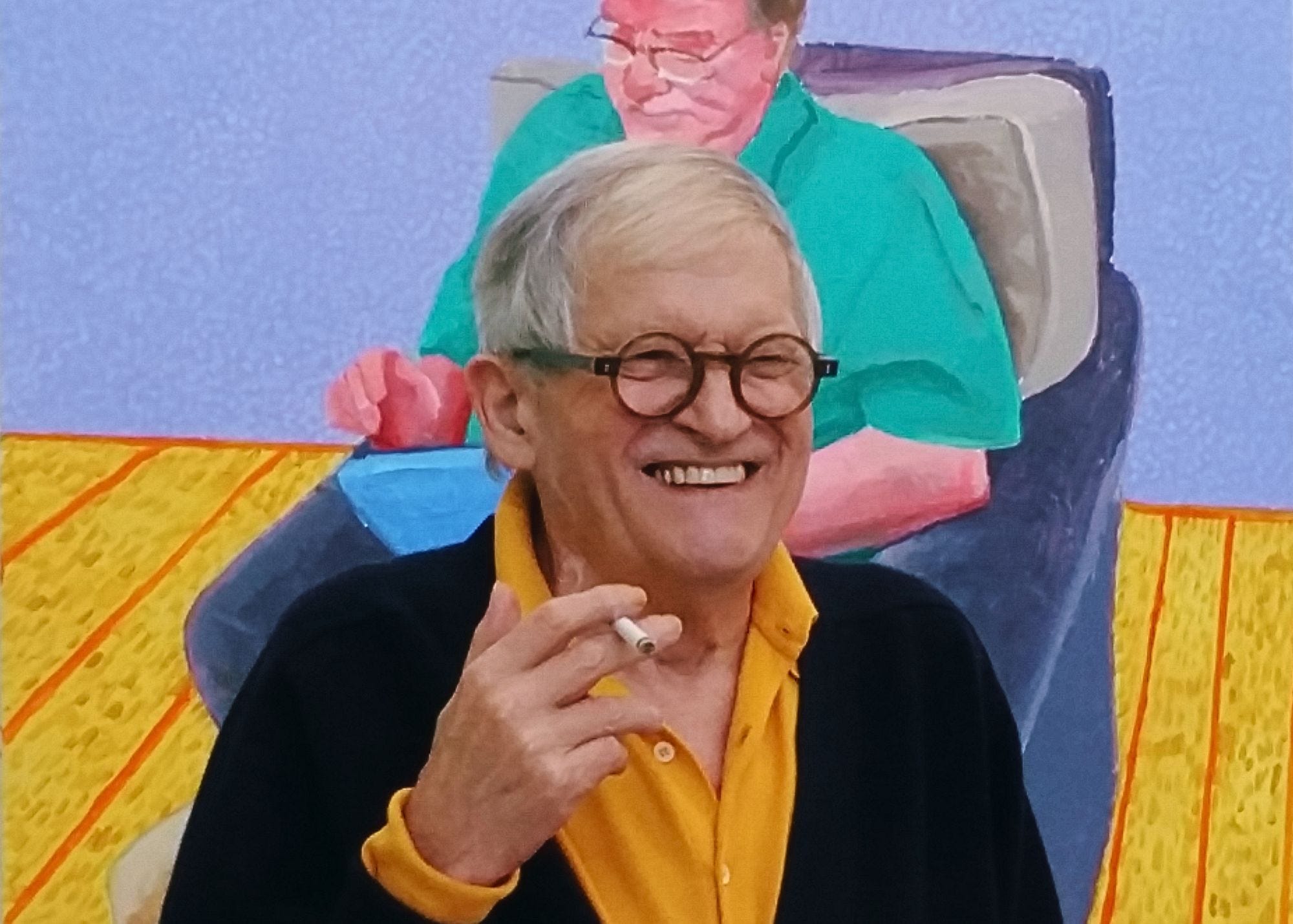
It seems inevitable that with this show Hockney will yet again be described as Britain’s Greatest Living Artist, especially now that Lucien Freud has passed. But he shoos away such honorifics. “It’s meaningless to me. That’s just the press doing that,” he says. He turned down a knighthood in 1990 because “I didn’t want to be Sir David, frankly,” and only accepted the Queen’s Order of Merit in 2012 because “there’s only 24 people who get it, so I thought I might as well. But it doesn’t mean much to me. The exhibition will mean more.”
I remember Goethe’s comment, when critics started at the end of the 18th Century. He said, “Would Shakespeare be able to develop now?” Because there wasn’t any criticism in Shakespeare’s day. He just did another play and another. If he’d been analyzing all the plays what would that have done?
Does he get nervous about critics before a show? “No, I don’t care. Why would you? I think you need critics, because you need publicity. That’s all they’re doing really. Serious criticism is not done in newspapers.” Besides, Picasso didn’t care about critics, and there’s no artist that Hockney admires more. “There’s no repeats in Picasso. You can go on discovering him 30 years after he died.”
His portraits are all priced at a handsome UKP1.3 million, so I ask him what he makes of the price of art these days. “Oh it’s so ridiculous,” he says. “I just assume it’s drug money. Because that money isn’t sitting in cardboard boxes in Columbia. It’s being invested.” Does he know what his personal record is? “Somewhere in the $7-8 million range, I think. But I don’t think about it. I’ve always had enough money to do what I wanted to do, for the last 55 years, even when I didn’t have much. And that’s all I’m interested in. What’s money for if not that?”
If longevity is your aim in life, it’s life denying I think. Because you’ve got to live. There used to be a joke – though nobody’s laughing today – where a man goes to the doctor and the doctor says, ‘I want you to give up smoking, drinking, rich food, and sex.’ The man says, ‘will I live long.’ ‘No, but it will seem that way.’
He didn’t come from money. His parents were a modest couple from Bradford — his father a clerk and outspoken communist, and his mother a housewife who raised David and his four siblings. And his childhood was a happy one. He adored his parents. Remarkably for the time, they accepted that he was gay and that he wanted to paint for a living - not the easiest path for a Yorkshire teenager in the 1940s. And with their blessing he went from Bradford College of Art at 16, to the Royal College of Art in London, where he fell in with RJ Kitaj and Peter Blake. Straight away, his talent and confidence were obvious. When the RCA refused to graduate him because he hadn’t submitted an essay, Hockney demanded they judge him solely on his art, and ultimately, the RCA changed its rules to pass him.
He moved to Los Angeles in 1964 because “no one asked you where you’d been or where you’d come from.” He’d been teased at school for his Yorkshire accent, but in LA, there was none of that. And it was easier to be gay. “There was a big gay bar here in 1964, the Red Raven, when there wasn’t even one in New York.” His career blossomed. He became known for his pool paintings, his depictions of gay relationships, the sweet portraits of his parents. He moved to London, then Paris, then LA again, but wherever he went, he was, in his words, in ‘bohemia’ — a state of mind and a way of living that he has cherished his whole life. “In 1960, it was illegal to be gay, but I pointed out that I lived in bohemia, and in bohemia you can be gay.” A flick of the wrist. “You can be anything.”
If it’s a minority, you’ve got to be tolerant. You shouldn’t go on about smoking because it’s a bit intolerant.
Naturally, there were drugs in bohemia, and Hockney dabbled as much as the next man. But work always came first. “I’d take cocaine with Gregory [Evans] - who’s now sober – and he’d always want more,” he chuckles. “I’d say, ‘don’t you think that’s enough for the time being? There’s work to do!’”
He misses bohemia now. “New York is boring. The rents are too high for bohemia. If the young can’t go to a place, it’s going to die... What happened was you had bohemia and suburbia, and then the suburban became a bit more bohemian. But then they started on their no-smoking, no this, no that. Well, that’s not bohemia... With minorities you’ve got to be tolerant, and smokers are a minority. So you shouldn’t go on about smoking, because it’s a bit intolerant.”
For Hockney, cigarettes are a symbol of bohemia, and he proudly describes himself as a “militant smoker”. When he asks if I smoke and offers a Davidoff Magnum Classic – “bigger, wider, very very smooth” – there seems only one polite response.
The past is edited, so it always looks better than the present, which is a jumble. But most of today’s art is going to disappear. We only keep the cream, and that’s as it should be. Otherwise we’d be up to our necks in rubbish.
“I know how fanatical anti-smoking people can be because my father was one,” he says. “In 1999 I was invited to a Labor Party conference in Brighton, to talk about smoking and there was this man with a big sign saying “100 million people were killed by tobacco in the 20th century.” And I thought, that’s my father. He’d be like this. So I pointed out that 100m people were killed in the 20th century for political reasons, and their deaths were terrible. The ones from smoking died in their beds. You can’t use the word ‘kill.’”
His dad died at 76 from diabetes. “I’ve outlived him now by three years. Say no more!” he says, grinning. “I’ve been smoking for 62 years, so why stop now? Picasso smoked, died at 93. Matisse smoked, died at 84. Monet smoked, died at 86. What are they going on about?”
I’ve always had enough money to do what I want to do, for the last 55 years, even when I didn’t have much. And that’s all I’m interested in.
The decline of smoking aside, he’s a fan of modernity. For one thing, he finds it more peaceful. “Have you read Stephen Pinker’s book, The Better Angels of Our Nature?” he says. “Violence is going down.” He also loves the technological advances, and not only for their artistic potential. IPhones, he says, have transferred power from the aristocracy to individuals. “Would you have had the slaughter of the first world war if everybody had an iPhone? I doubt it. People would be sending their messages: ‘don’t come to the Somme!’”
As for gay marriage, he didn’t see that coming at all. Not that he was ever tempted himself to get married or raise a family. His last lover was John Fitzherbert and they split in 2009. “I always thought I’d be single,” he says. “But I have a family of another sort. Everybody does in a way. And I think artists are not that good parents. I’ve known a few. They think about their work too much.” He pauses for a moment. “So I’ve missed out on some things, I would say that. But you manage in life, don’t you? I remember once at Glyndebourne, the New York Times had an article about the social scene, the picnics and things, and they asked the press secretary, ‘what do you do if it rains?’ And she said, ‘we manage.’ That’s a very good answer. That’s what I’ve done. You make up with some things what you lose on others.
When you know a lot about history, politics is just politics.
Perhaps the greatest loss Hockney has had to bear has been his hearing. It started to recede in the 70s, and has worsened ever since. “That was why I didn’t like Studio 54, because I couldn’t stand the sound,” he says. It was hereditary—both his father and sister went deaf. “I’m sure my father never heard a word my mother said in the last 10 years of his life, because she spoke so softly. But I knew why,” he says. And he walks over to me and puts his arm around my shoulders and leans in. “Because then we had to go close and listen like this!”
Deafness has dramatically curtailed his social life. He avoids crowds and seldom goes into town anymore. Occasionally, he’ll invite friends over, but even then, he struggles if more than one person is talking at a time. And there’s no music anymore. No more concerts or opera. “I leave depressed. It’s just not rich anymore. It gets me down sometimes.”
I can see how homosexuality could be attacked again for the simple reason that most people who have a child want a grandchild.
In his biography of the artist, the author Christopher Sykes speaks of periods of depression and darkness, but Hockney shakes his head, ever so subtly. “He didn’t get everything right in that book.” He was never depressed in the clinical sense, he says. Although, there was one time when he wouldn’t get out of bed for three days, and Gregory Evans despatched him for treatment to a clinic in Pasadena. “It was absolutely charmless. Not a single flower. They put me in this room and the only picture on the wall said ‘no smoking’. And then the man asked, how many times had I tried to kill myself? Well, I hadn’t, so I got out of there. But when I went to the doctor, he told me, you’re prone to pancreatitis, so I’d advise you to give up alcohol and caffeine. I said, ‘well, as long as I can smoke.’ And I’ve never experienced that since. So now I realize. It was always after a drink.”
It’s time to take some pictures, so we head out to his garden, into a classic LA scene, the kind he might paint – blue skies and palm trees, a crystalline pool of course, and a shoot in progress. The portrait artist getting his portrait taken.
People with good hearing are not that sympathetic to deaf people. They don’t understand that you’re not just losing volume, you’re losing the ability to tune out background noise to focus on something. At an art opening, I can’t hear the person talking to me, I just hear all one sound. I stopped going to openings about 1970.
As the photographer snaps away, his thoughts turn to his adoptive home. For as English as he feels, and as much he looks forward to his London show – staying in his Kensington apartment, and treating himself to the baths at Baden Baden afterwards, “very very relaxing” – home is here now, in the balmy idyll of Montcalm Avenue.
“You live very privately in LA,” he says. “You get in your car and go to someone else’s house, and you’re not meeting people on the street like in London and New York.” Not that he drives himself about anymore, not since 2013 – Jonathan takes care of that now. “I’ve always loved LA because it’s spread out and New York is vertical, which is a perspective nightmare for me!”
Hockney can talk about perspective all day long. Few artists have studied it in such depth. So he happily ambles down a tangent about how Chinese painting has no shadows, only European painting does, and that’s because Renaissance artists used a camera obscura which he famously proved and can show you if you’ve got a minute... But JP is looking at his watch. Work beckons. JP is the keeper of Hockney’s schedule, and he runs a tight ship.
“Five minutes,” he announces. “David must break at 1pm.”
You live privately in LA. You get in your car and go to someone else’s house, you’re not meeting people on the street like in London or New York. Often what I do is drive from here and in 25 minutes, I can be 5000ft up the mountains. Then I drive back down to the nonsense.
The whiff of lunch wafts across the garden – Hockney’s two housekeepers have the table set and ready. So I ask him about mortality. After all, he’s in his autumn, if not his winter quite yet.
“Well, I know I’m going to die,” he grins. “And I think about it more now. But what do artists do? They go on to live all over. And I think maybe my art will go on because the young are interested in it.”
He produces a fresh packet of Camel Lights, and sparks up maybe his sixth of the interview, savoring the smoke and squinting into the sunshine. “You know, I like to live in the now, but this Taschen book has made me look back. And there’s all this work. And I’m quite impressed with it!” He giggles. “Some’s better than others, but I haven’t wasted my time. No, it’s going to be a very nice book, and everyone will see that I was always just an artist, concerned with how to represent the 3D world in 2D. I’ve always been asking questions about that really.”
Lovely piece. LA for the win!!
Fantastic piece, Sanj! You captured his essence so beautifully and I love that you shared a smoke with him. What a rare spirit he was.